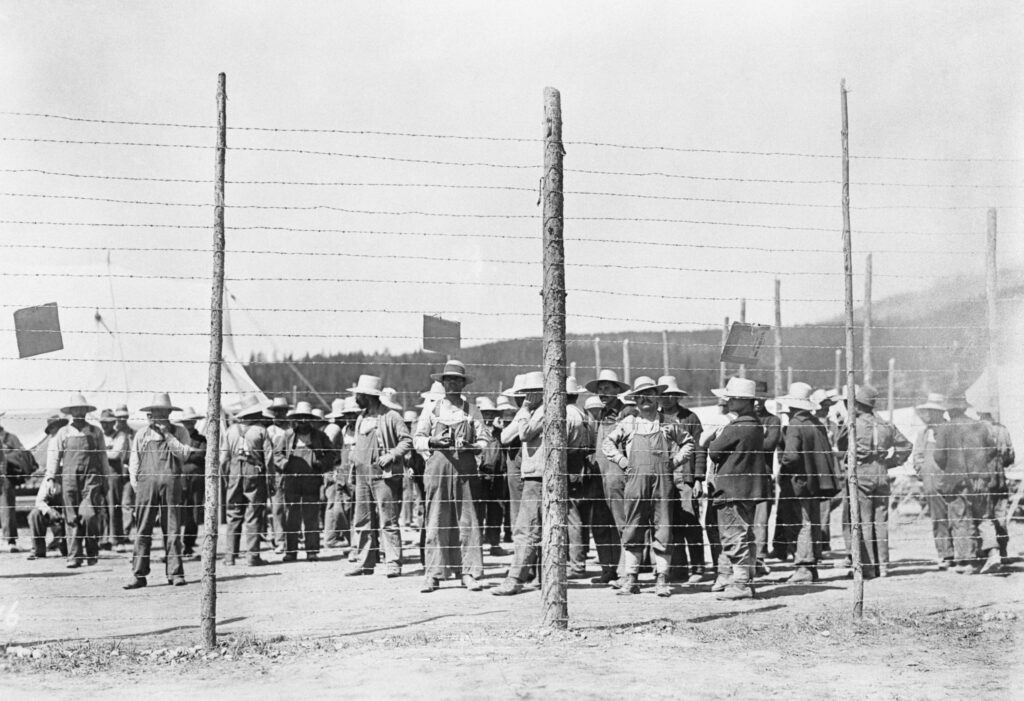

The early 20th century in Canada was a period of mass immigration, with Ukrainians making up a significant portion of new arrivals. The government promised equal citizenship and support to all newcomers in their pursuit of a better life.
However, during World War I and the two years following it (1914–1920), Canada conducted its first national internment operations. Internment involved detaining individuals, either citizens or nationals of enemy states, without trial for the war’s duration and beyond.
At the time, Western Ukrainian territories were part of the Austro-Hungarian Empire. As a British dominion, Canada fought against Austria-Hungary and claimed the right to intern individuals with citizenship in that empire. Alberta became part of this dark chapter in Canadian history with the Castle Mountain Internment Camp, located in Banff National Park. This camp was the largest in the Rockies. More on calgaryes.com.
Internment in Canada
Most of those interned were ordinary immigrants of Ukrainian, Austrian, Hungarian, and German descent. Despite being civilians, they were sent to camps as a source of forced labor. The only grounds for internment were ethnic origin, not individual actions or crimes. Both men and women, as well as children, were detained.
Canada established 24 internment camps nationwide. Of the 70,000 immigrants from Austria-Hungary, 8,579 were interned, and their property was confiscated. Only 3,138 of these individuals were categorized as “prisoners of war,” while the remaining 5,541 were civilians, approximately 5,000 of whom were Ukrainians. Over six years, they endured unjust repression, labeled as Austrians and, consequently, enemies.
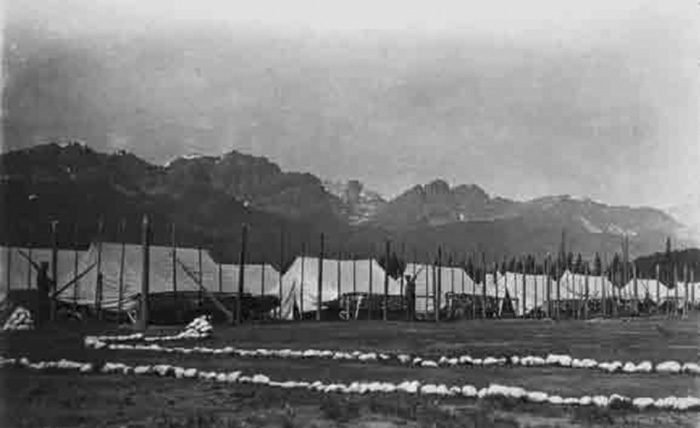
Furthermore, over 80,000 Canadian settlers, mostly Ukrainians, were declared “enemy aliens” and required to report regularly to law enforcement. They carried identification numbers and were arrested or imprisoned for even minor infractions.
At that time, Ukrainians formed the largest Eastern European immigrant community in Canada. Other groups, such as Poles, Italians, Croats, Bulgarians, Serbs, Turks, Hungarians, Jews, and Russians, constituted smaller minorities. Interestingly, German prisoners and German-speaking Austrians were classified as “first-class” internees and housed in relatively comfortable camps near Kingston, Ontario.
Life in the Camp
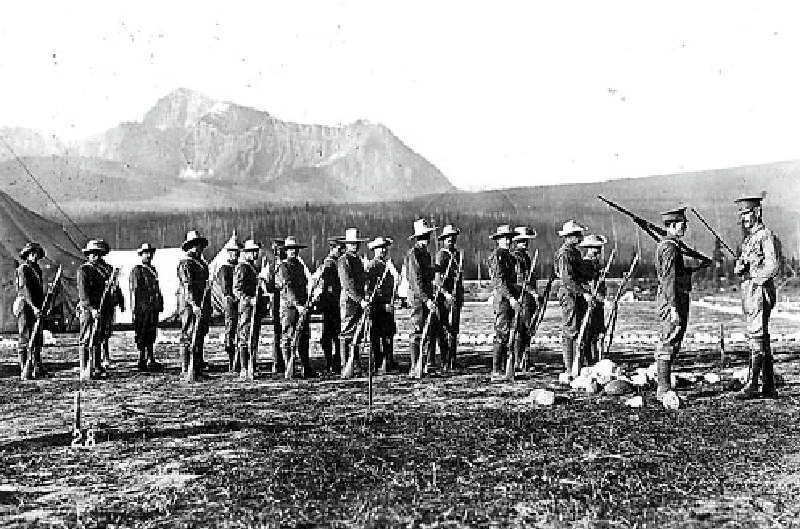
The Castle Mountain camp operated from July 1915 to August 1917. A total of 660 internees worked on various projects in Banff National Park, then known as Rocky Mountain Park, which was being developed as Canada’s first national park. They were overseen by 180 guards and paid 25 cents per day.
The camp consisted of tents surrounded by barbed wire, unsuitable for the harsh winter climate, forcing a relocation to military barracks near Banff’s Cave and Basin hot springs.
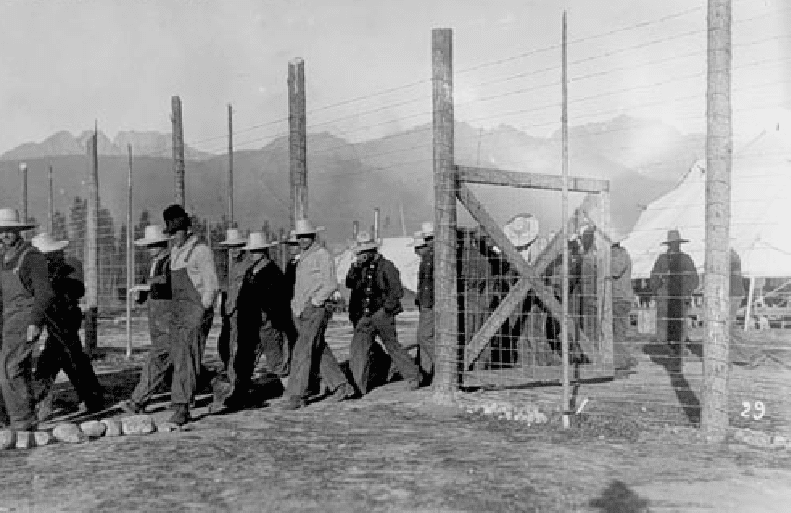
Due to the area’s tourist appeal, the main goal of Castle Mountain was to use the internees to extend Banff’s highway to Lake Louise. They also built bridges, culverts, firebreaks, trails, and drainage systems for recreational areas, reclaimed land for tennis courts, golf courses, shooting ranges, and ski jumps, quarried stone for the Banff Springs Hotel, and repaired streets and sidewalks.
Internees across Canada were denied access to newspapers and correspondence. They frequently protested their conditions. For instance, in 1916, approximately 1,200 prisoners and 300 guards staged a riot at the Kapuskasing camp in Ontario. In British Columbia and Nova Scotia, Ukrainian internees working in mines and factories organized hunger strikes, demanding repatriation to Austria or relocation to Ontario. Some, unable to endure the humiliation, committed suicide. At Castle Mountain, at least one suicide and 60 escape attempts were recorded.
Managing the camp was challenging, and escapes were common. Neutral observers and foreign governments often criticized the conditions, accusing Canada of failing to meet international standards for interning enemy aliens.
Closure of the Camp
In spring 1917, the camp returned to Castle Mountain. The relocation process continued until August 1917, when the camp was permanently closed. The remaining 47 prisoners were transferred to another camp in Ontario, where they worked in the industrial sector to address labor shortages.
The Castle Mountain camp was quickly dismantled and left to the wilderness. Following its closure and that of the Cave and Basin camp, most internees were pardoned, although many remained under police supervision.
Legacy
A wooden poplar cross was erected at Castle Mountain to remind visitors of this tragic chapter in Canadian history, but it was later removed.
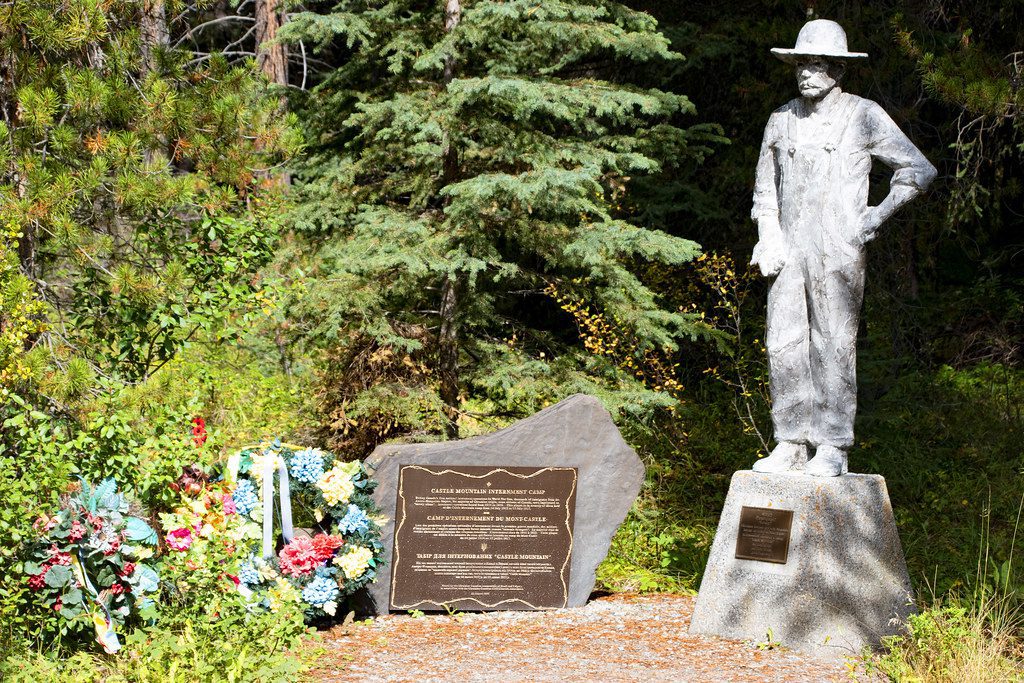
After extensive lobbying by the Ukrainian Canadian Congress for acknowledgment and accountability, including restitution for the injustice suffered by Ukrainians during 1914–1920, the federal government agreed in 1994 to establish an official memorial at the site.
In 1995, a memorial titled “Why?” was installed at the base of Castle Mountain by the Ukrainian Canadian Civil Liberties Association to honor the Ukrainian internees. Dutch sculptor John Boxtel created a statue of a Ukrainian Canadian internee.
The actual site of the camp has been obscured by forest to deter artifact hunters, and its precise location remains undisclosed. However, visitors who stumble upon remnants of the camp may find remnants of barbed wire, bleached stones, wood fragments, and tin cans.
In 2005, Canadian Prime Minister Paul Martin acknowledged the internment of Ukrainians as a dark chapter in the country’s history. In 2008, the Canadian government created a $10 million fund to finance projects dedicated to those affected during that time. That same year, an interpretive center was established at the Cave and Basin historic site.
On June 5, 2012, the head of the Ukrainian Greek Catholic Church, Patriarch Sviatoslav, visited the Castle Mountain memorial and held a memorial service to honor those interned as “enemies” during Canada’s first national internment operation.
On August 22, 2014, 100 aluminum plaques featuring photos of interned prisoners were installed at the site. In 2020, relatives of internees and members of the Ukrainian diaspora held a ceremony marking the 25th anniversary of the “Why?” memorial’s unveiling.
Canada observes National Internment Day on October 28 to commemorate this somber chapter in its history.