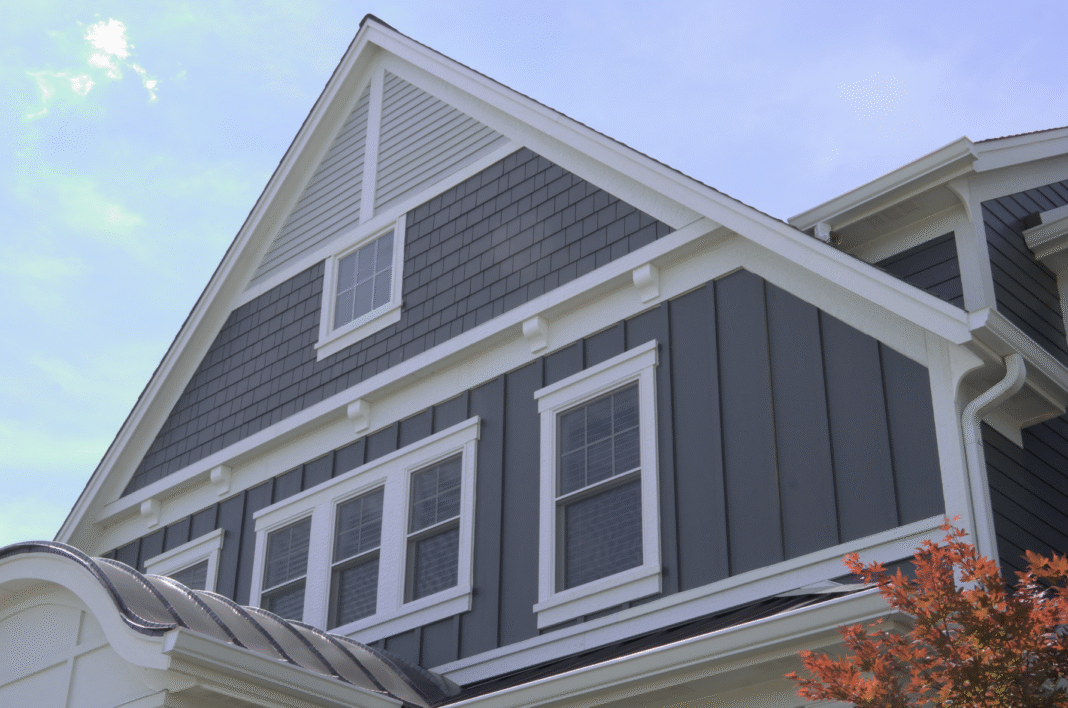

Calgary carries an unusual civic title: hailstorm capital of Canada. The city sits inside what meteorologists call Hailstorm Alley, a corridor stretching from High River through Red Deer to Rocky Mountain House, where Rocky Mountain air collides with prairie heat to produce some of the most violent hail cells on the continent. For homeowners, this geography is not a curiosity — it is the single biggest factor determining which siding actually survives on a Calgary house. Here is what the record shows, and what it means for material choice.
1. A city built in the storm’s path
On 7 September 1991, tennis-ball-sized hail battered Calgary, triggering 62,000 insurance claims worth $342 million. At the time it was the costliest hailstorm in Canadian history, and a warning that went largely unheeded in how new homes were clad over the following decades.
2. 2020 broke every previous record
Nearly three decades later, the storm of 13 June 2020 surpassed 1991 many times over, ranking as the fourth-costliest natural disaster in Canadian history. Roofs, vehicles and exterior cladding across entire neighbourhoods were destroyed within thirty minutes, as golf ball-sized stones fell alongside flash flooding severe enough to blow manhole covers off city streets.
3. August 2024: the second-costliest disaster on record
A hailstorm that struck Calgary in August 2024 caused close to $2.8 billion in insured losses, ranking behind only the 2016 Fort McMurray wildfire as Canada’s costliest disaster. Tens of thousands of homes across the city’s north lost siding and roofing in a single evening, with entire streets left showing bare sheathing where cladding used to be.
4. Building codes haven’t caught up with the risk
Researchers studying the aftermath were blunt about the material at the centre of the damage: standard vinyl siding performs among the worst of any exterior product in a severe hail event, cracking and shattering rather than absorbing the impact. Yet it remains the default on new builds, because federal building codes, which provinces can only adjust rather than rewrite, do not currently mandate impact-resistant cladding even in acknowledged high-risk zones such as Calgary.
5. Why insurers keep pushing for change
With Alberta hailstorms now costing insurers roughly $6 billion over five years, the Insurance Bureau of Canada has repeatedly called for climate-resilient construction standards, rebates for impact-resistant materials, and tighter rules for building in hail-prone regions. Calgary sits at the top of that list every time the figures are published. For anyone assessing a property or planning a renovation in the city, checking local conditions through a resource such as https://familysiding.com/locations/siding-calgary/ is a practical starting point before deciding what to install.
6. What “impact-rated” actually means on a spec sheet
Materials such as fibre cement panels and Class 4-rated steel siding are engineered to absorb a direct hail strike without cracking, denting, or losing their weatherproof seal. The rating system exists precisely because the gap between ordinary and impact-rated products is not marketing language: it is measured in laboratory tests using steel balls fired at panel samples, and Calgary’s storm history is the reason that testing matters here more than almost anywhere else in the country.
7. Risk is not spread evenly across the city
North Calgary communities such as Evanston and Livingston have been struck repeatedly within the same four-year window, a pattern that researchers attribute to local topography and storm-track behaviour rather than chance. That clustering strengthens the case for upgrading cladding after a strike rather than simply repairing it, since a second or third event in the same postal code is now a realistic planning assumption rather than a worst case.
8. Choosing material with the next storm in mind
Until codes catch up with the climate, the decision falls to homeowners rather than regulation. Vinyl remains popular for its price and low upkeep, and contractors installing https://familysiding.com/services/vinyl-siding/ in the city now typically use heavier, impact-tested profiles rather than the lightest-grade panels once standard on Calgary builds. In the highest-risk pockets identified after 2020 and 2024, though, pairing that with reinforced installation, or moving to a Class 4 steel or fibre cement product outright, is increasingly treated as ordinary prudence rather than an upgrade.
Given the trajectory from 1991’s $342 million storm to 2024’s $2.8 billion one, Calgary’s next major hailstorm is a matter of when, not if. Understanding which materials actually hold up is no longer a renovation preference; for anyone who owns a home in Hailstorm Alley, it is basic risk management.